A Simple Way to Organize Digital Files Before They Pile Up
A light routine for naming, sorting, and archiving personal files across devices, with a hypothetical example of putting the method to work.
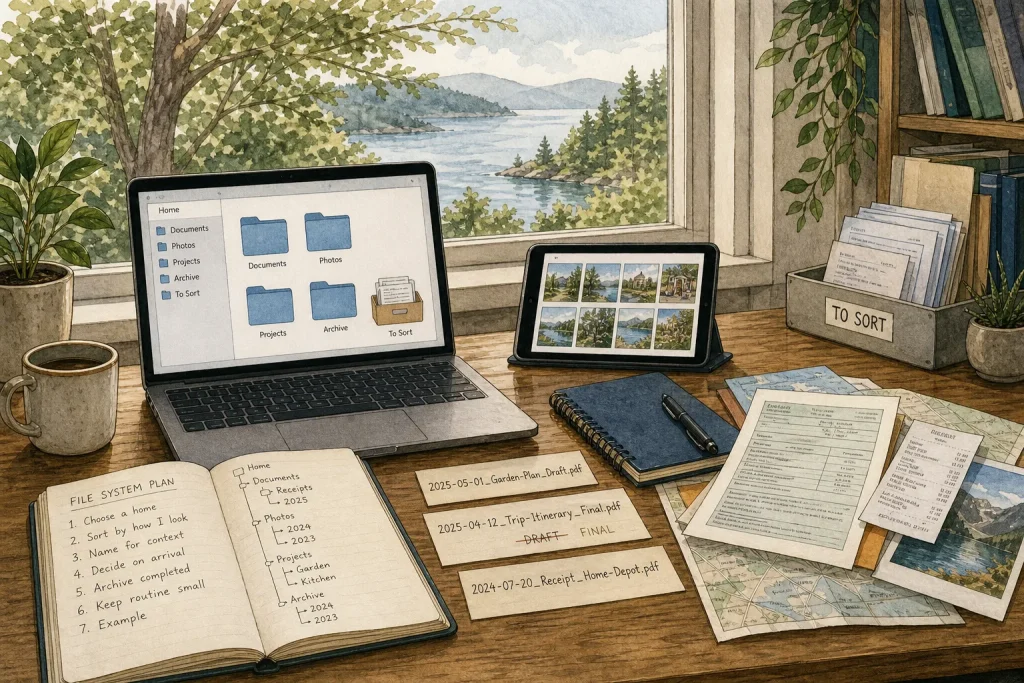
A downloaded form lands beside a scan of a receipt, a draft itinerary, and three files named “final.” None is hard to open; the trouble is remembering which one matters. A manageable file system does not require a perfect taxonomy. It needs a few consistent choices made close to the moment a file arrives.
The approach below works across a computer, phone, tablet, or cloud drive. Start with a small number of folders, use names that describe contents rather than moods, and move older material out of the way without making it disappear.
1. Give each file one dependable home
Choose a primary place for personal files: a folder on your computer, a cloud drive, or another storage location you already use. The aim is not to keep every copy in one physical place. It is to establish one place where you look first and where the current version belongs.
Set up a few broad folders inside it, such as Documents, Photos, Projects, and Archive. Adjust the labels to match your life. Someone who keeps household paperwork may prefer a separate Home folder; someone who rarely handles project files may not need that category at all.
A folder should answer a useful question. “Where would I look for a passport scan?” is more helpful than “Which of my twelve categories is most technically accurate?” Avoid creating a new folder for every individual file. When a category has only one item, a broader home is usually easier to remember.
2. Sort by the way you will look for something
People commonly search by subject, project, or date. Pick the organizing principle that best fits the material, then use it consistently within a folder. For instance, Projects might contain one folder per ongoing project, while Photos might be grouped by year or event.
Mixing principles at the same level can make choices harder. A folder list containing “Travel,” “2023,” “Kitchen,” and “Receipts” asks the user to switch between subjects, dates, and document types. Instead, put those distinctions in layers: Documents/Receipts, then a year or household subject if it helps. Keep the structure shallow enough to browse without opening a chain of folders.
Sorting is a practical compromise, not a claim that each file has only one meaning. If a document could fit in several places, choose the location where you would most likely search. A clear filename can carry the other context.
3. Name files for their contents and context
Replace names such as “scan,” “document,” or “new version” with words that identify the file when it appears in a search result. A useful pattern is date, subject, document type, written in a consistent order. For example: 2025-04-12_Garden-Plan_Notes. Use dates only when they help distinguish versions or events.
Prefer plain words and a modest amount of detail. A filename should be readable on more than one device, so avoid relying on visual formatting, unusual symbols, or a very long sentence. If a file has a status that matters, add a clear term such as “draft” or “signed” rather than “final-final.” Remove that status when it no longer describes the file.
When a document is replaced, keep the new name understandable without opening it. If earlier versions are needed, place them in an archive or add a date to each version. Do not leave several competing files with identical names in different folders unless you have a clear reason to keep both.
4. Decide what to do when a file arrives
Downloads and attachments tend to gather because they have no assigned destination. When you save a file, make a quick choice: keep it, move it, or discard it. If it is useful, give it a descriptive name and put it in its home rather than leaving it in a general downloads area.
For a file that needs attention later, use a temporary holding folder such as To Sort. Keep that folder visible, and treat it as a short-term queue rather than a permanent category. During a regular tidy-up, open each item and decide where it belongs. If a file is no longer useful, delete it; if it is uncertain, consider whether keeping it serves a real purpose.
Some documents contain personal or sensitive information. Before deleting or sharing them, consider the file’s contents and the storage service or device involved. For questions about records that have legal, financial, or other formal significance, seek advice from a qualified professional rather than relying on a folder system to decide what must be retained.
5. Separate active material from the archive
Active folders should make current work easy to find. An archive should hold material you may need again but do not need in everyday browsing. You might archive completed projects by year, move old travel plans out of an active folder, or retain a past version of a household document when its history matters.
Use a simple rule for moving files: archive when the work is complete or the information is no longer current, not merely because a folder looks crowded. Before moving a group, make sure the names will still make sense in the destination. “Notes” may be clear inside an active project folder but ambiguous when separated from it; rename it with the project or subject included.
An archive is not the same as a backup. An archive organizes material you intend to retain. A backup is another copy intended to help recover files if the primary device or account becomes unavailable. Keep those purposes distinct, and follow the guidance for the device or service you use if you need to protect important files.
6. Make the routine small enough to repeat
A file system stays useful through modest maintenance, not a dramatic cleanup that you never want to repeat. Choose a regular moment that already exists in your routine, such as the end of a household paperwork session or a monthly computer check. Review the temporary holding folder, rename obvious strays, and move completed material to the archive.
Search can help locate a file, but it cannot fix a name that tells you nothing. When you find an unhelpfully named document, improve the name then, while its contents are open and its subject is clear. That small repair makes the next search easier without requiring a full reorganization.
Resist the urge to add folders every time a new kind of file appears. First ask whether an existing category can hold it and whether the filename can supply the missing context. Add a category only when the same kind of material recurs and a separate home would make retrieval simpler.
7. Work through one realistic example
Hypothetical worked example: Imagine a person starting with a laptop’s Downloads folder, which contains a signed rental form, a receipt for a household repair, and a draft list of items for a weekend trip. They want to keep the signed form and receipt, but the trip list is still changing. Their constraint is that they use both a laptop and a phone, so the folder names need to remain clear in either place.
They create Documents/Housing, Documents/Receipts, and Projects/Weekend Trip in the chosen primary storage location. They rename the files to Lease-Agreement_Signed, 2025-04-12_Plumbing-Repair_Receipt, and Weekend-Trip_Packing-List_Draft. The signed form goes in Housing, the receipt goes in Receipts, and the changing list stays with the trip project. When the trip is over, they can archive that project rather than leaving it among current work.
The expected result is not a flawless catalogue. It is a small set of predictable destinations and filenames that make the next search less dependent on memory. The tradeoff is that the person must make a brief decision when saving or reviewing files. That modest effort is easier to sustain than rebuilding an elaborate system whenever clutter becomes visible.
Start with the next file you save, not every file you have ever collected. Give it a sensible name, put it where you would look first, and let that choice become the pattern for the next one.