How to Make Shared Household Objects Easier to Use
A misplaced peeler or an ambiguous key bowl can turn a shared space into a daily guessing game. Learn how to observe the snag, agree on a simple convention, and use a small environmental cue to make the routine clearer.
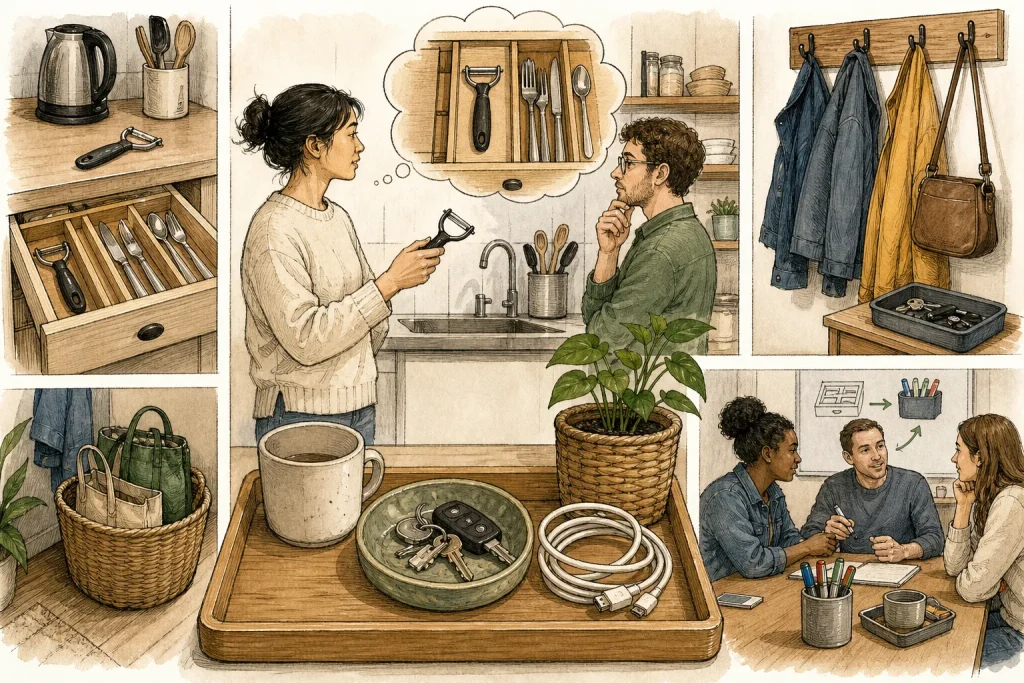
A vegetable peeler turns up beside the kettle, then in a drawer with the cutlery, then nowhere anyone can find it. In a shared kitchen, that small search is a practical signal: people do not have a common answer about where the tool belongs. The same kind of confusion can gather around keys, charging cables, reusable bags, and the mugs beside an office sink.
A useful household convention makes the next action easier to see. It may be a familiar habit, a short agreement, or a physical cue such as a tray or label. The best choice depends on who uses the object, how often people change, and what happens when someone guesses wrong. A few deliberate observations can help a household solve the recurring snag without turning every drawer into a rulebook.
Trace the moment when the routine breaks down
Start with one object and one ordinary interaction. Notice who reaches for it, where they look, and what they do when it is missing. Then consider what happens after use: who cleans it, returns it, or notices that it has not come back? These details reveal whether the problem is an unclear location, conflicting expectations, or an uneven share of the work.
For example, people may agree that dishes belong in the sink but disagree about whether someone should wash them immediately. A label naming the sink would not resolve that difference. By contrast, if everyone expects the peeler to go in a particular drawer but cannot remember which one, a visible cue may be enough.
It also helps to distinguish a genuine need from an inherited habit. A basket by the door might keep reusable bags within reach; it might also be there simply because someone once set a basket down. Ask what the arrangement helps people do. If nobody can name a useful purpose and it creates friction, the household can consider changing it.
Use familiar habits when people can learn them easily
A familiar convention is passed along by example. Someone sees shoes gathered near the entrance and removes their own. A visitor watches where a host puts the shared water jug and follows suit. This works well when the setting is stable and newcomers can read the cue without having to guess about personal preferences.
But a habit that seems obvious to longtime residents may be invisible to a guest or new housemate. A plain mug on a shared shelf may be someone’s personal cup, not a communal one. If a mistaken guess could embarrass someone or lead to an unwanted use of their property, explain the preference directly or mark the object clearly.
Keep a familiar habit when it serves a recognizable purpose and people can learn it without discomfort. If the same question comes up repeatedly, treat that as a sign that the convention needs a clearer explanation or a better cue. The point is not to preserve a routine just because it is old; it is to retain what helps and make the rest legible.
Agree on a rule when people share responsibility
When several people use an object and expect different things, a brief conversation can replace guesswork. Focus on the recurring point of confusion rather than trying to regulate every detail. For a shared tool kit, the group might agree that the tape measure returns to a labeled drawer. For a set of meeting-room supplies, users might decide that markers go back in a cup on the table after each gathering.
Make the agreement concrete enough to follow. “Put things away” leaves open where they go and who is responsible. “Return the peeler to the small utensil drawer after washing it” identifies both the destination and the action. If the routine involves cleaning or restocking, discuss who does that work; a rule can look neutral while quietly assigning the task to one person.
Keep the agreement modest and make it revisable. A detailed inventory of every kitchen utensil can create more supervision than the objects require. A short check-in is often enough when an arrangement stops working: ask whether the location is still convenient, whether the task is shared fairly, or whether the object needs a different home.
Put a cue where the decision happens
A physical cue can help people act without relying on memory or a conversation. A tray beside the entrance can show where shared keys belong. A hook near the place where coats come off can make their intended home apparent. A label inside a drawer can help distinguish it from similar drawers without covering the whole kitchen in signs.
Place the cue where someone naturally reaches for or returns the object. A return bin across the room may be easy to overlook; a small container beside the work surface is more visible at the moment it is needed. If a cue is repeatedly ignored, do not assume that people are careless. The location may be inconvenient, the label may be unclear, or the agreed action may not fit the routine.
Designing a cue does not settle every question. A basket for used mugs may make the destination clear, but it does not decide who washes them. A labeled shelf may prevent misplaced supplies while leaving an unfair cleanup arrangement untouched. Pair the physical cue with a conversation when the underlying issue is responsibility rather than location.
Choose a response by checking what you observe
Use the following checks to decide whether a familiar habit, a shared agreement, or a physical cue is the most useful response. Each observation points to a next action, with an alternative if the first choice does not fit.
- People already return the object to the same place: If everyone can find it and the location serves a clear purpose, keep the familiar habit; otherwise, ask users what makes the current location inconvenient.
- Newcomers pause or ask where the object belongs: If the answer is consistent, add a short explanation or a visible cue; otherwise, discuss and choose one shared destination first.
- Regular users disagree about the object’s location: If they can agree on a convenient place, state that agreement plainly; otherwise, try a temporary shared location and revisit it after people have used it.
- The object is easy to find but often left dirty or unusable: If the missing task is clear, agree who will do it or when; otherwise, ask whether cleaning or maintenance is the real source of disagreement.
- A label or container is repeatedly ignored: If users say the cue is hard to see, move or clarify it; otherwise, reconsider whether the agreed routine is practical.
- A wrong guess could affect personal property, privacy, or comfort: If the owner’s preference is known, explain it directly and respectfully; otherwise, ask before using the object rather than relying on an ambiguous hint.
- The convention creates more reminders than it prevents confusion: If a simpler arrangement is possible, remove unnecessary instructions; otherwise, keep only the cue that resolves the recurring question.
Work through one household decision
Imagine three housemates looking for a shared vegetable peeler. The starting inputs are hypothetical: the peeler has no assigned home, it has appeared in several kitchen drawers, and each person wants to find it without asking. One housemate thinks it belongs with the knives; another looks for it with the other small utensils; the third sometimes assumes it has been lost.
First, the housemates identify the actual snag: the tool is hard to find because nobody has agreed on a location. They rule out a broader cleanup discussion because the peeler is already being washed after use. Next, they compare the two likely drawer locations and choose the small utensil drawer because it is where they keep similar hand tools. They agree that the person who washes the peeler will return it there. Finally, they place a small label inside that drawer, where it is visible when someone opens it.
The resulting decision is specific: return the clean peeler to the small utensil drawer. The expected observable result is that someone looking there can find it and that the person putting it away has a clear destination. The tradeoff is that the label occupies a little space and may become unnecessary once the routine is familiar. If the peeler still turns up elsewhere, the housemates can ask whether the drawer is inconvenient and choose a more practical location rather than adding more reminders.
Keep the rule smaller than the problem
Shared objects do not need elaborate systems to be easier to use. A stable habit may be enough when everyone understands it; a short agreement can resolve competing expectations; a tray, hook, or label can help when memory or turnover makes the routine unclear. Often these approaches work together: housemates agree where the keys belong and put a small tray in that spot.
When a convention causes friction, notice where the pause occurs and what people need to know at that moment. Then make the smallest change that addresses the cause: explain a preference, agree on a destination, or place a cue where the action happens. If the routine creates an avoidable burden for one person, include that person in the decision. The useful rule is the one people can understand, follow, and revise when the household’s needs change.