Turn a New Skill into a Repeatable Practice
A skill becomes easier to sustain when practice has a clear target, a manageable session, and a review that points to the next useful adjustment.
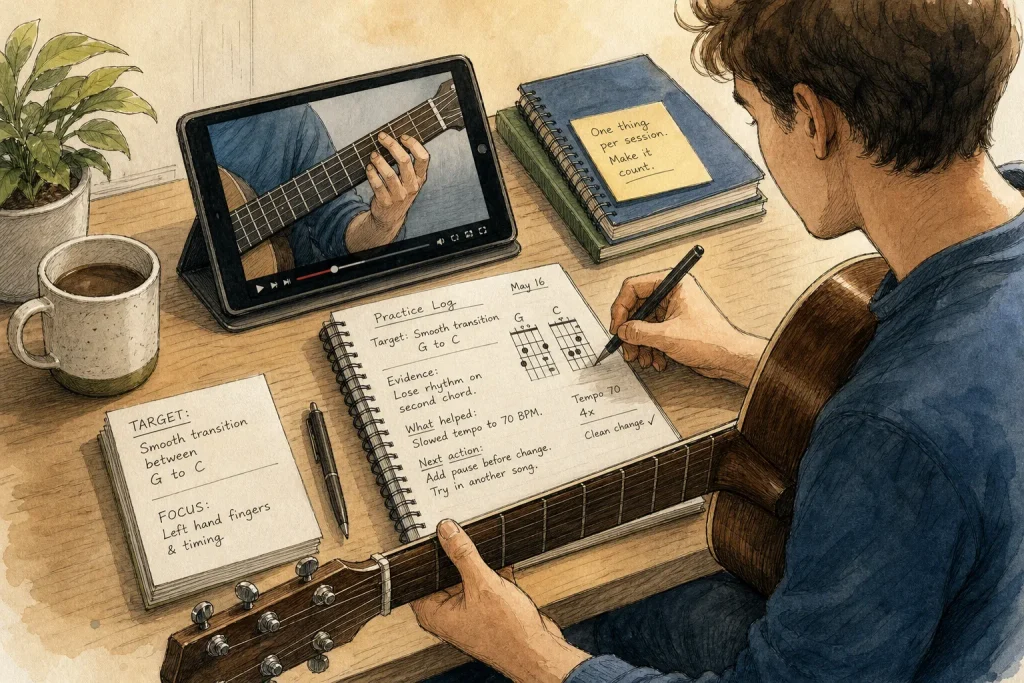
A beginner guitarist sits down after dinner, opens a lesson video, and spends the evening replaying the same section. The chord change still feels awkward, and it is hard to tell whether anything improved. The problem may not be effort. It may be that “practice guitar” is too broad to guide a session. A repeatable practice begins with a smaller question: what, exactly, will I try, and how will I know what to work on next?
Choose a skill you can observe in action
Start by describing the skill as something you do, rather than a quality you hope to acquire. “Become confident at drawing” is difficult to practise directly. “Draw a mug using a light outline, then add the handle and shadow” gives you actions to attempt and a result to inspect.
It helps to distinguish a skill from its supporting knowledge. Learning to cook a new dish involves knowing the order of the recipe, handling a knife, noticing when ingredients are ready, and coordinating several tasks. A single session cannot address all of those equally. Choose one part that matters now, such as cutting an onion into consistent pieces, and let the rest support that focus.
A useful target is narrow enough to practise in one sitting but substantial enough to connect to the larger skill. If it is too broad, you may drift between activities. If it is so small that it has no meaningful context, improvement may not transfer. A beginning piano student might focus on moving between two chords within a short passage, rather than either “learn piano” or “press this one key.”
Break the target into a manageable session
Give each session a simple shape: prepare, attempt, notice, and adjust. The preparation can be as modest as opening the same document, laying out a sketchbook, or setting a recipe and ingredients on the counter. A familiar starting routine reduces the work of deciding how to begin.
Then make a specific attempt. For language learning, that might mean saying a short set of phrases from memory before checking a notebook. For drawing, it might mean making several quick outlines before choosing one to refine. The point is not to fill a fixed duration. It is to create a useful encounter with the target, with enough room to notice what happened.
Keep the task demanding but workable. If every attempt collapses at the same point, simplify the conditions: slow the passage, use a shorter phrase, or remove a distracting tool. If the action feels automatic, add a modest challenge, such as changing the rhythm or applying the technique to a different example. Adjusting difficulty is not a retreat from learning; it is how you keep attention on the part that can still improve.
One session should not try to repair every weakness. A guitar player working on a chord change can leave tone, tempo, and a different song for another day. A narrow focus makes it easier to see whether the chosen action helped, and it keeps a practice routine from becoming a long list of unrelated chores.
Review evidence, not just effort
After a session, record a small piece of evidence and one next action. Evidence might be a sentence about where a transition became uncertain, a photograph of a sketch, a saved audio clip, or a marked passage in sheet music. The record should help you make a decision later; it does not need to document every detail.
Ask questions that connect the attempt to the target. What part felt more controlled? Where did the action break down? Did the material make the task too easy or too difficult? What would be a sensible variation next time? Avoid turning the review into a verdict on your ability. “I lose the rhythm when I move to the second chord” is more useful than “I am bad at guitar,” because it identifies something you can change.
Choose a review method that fits the skill. A sound recording can reveal hesitations that are hard to notice while playing. A before-and-after sketch can show changes in proportion. A short written note may be enough for learning vocabulary or a software procedure. Video can help with movement, but it also takes time to record and inspect; use it when seeing the motion would answer a question that sound or notes cannot.
Let the review shape the next attempt
Review only becomes useful when it informs the next session. Keep the target if it still needs attention. Reduce the difficulty if the attempt was too demanding to examine. Change the conditions when they were the obstacle, such as practising a recipe technique with a dull knife or learning a keyboard shortcut in a window that keeps stealing focus. Move on when the action is becoming reliable enough to try in a wider context.
Reliability does not mean performing perfectly once. It means the action holds up across sensible variations: a different passage, a new example, or a less rehearsed moment. The next session can test that transfer. A pianist who practised a chord change in one passage might try the same movement in another, while keeping the tempo comfortable. If it becomes uncertain, that is useful information: the skill may be tied to the original passage rather than fully available elsewhere.
Keep the record light. A notebook page with the date, target, observation, and next action is often enough. If the notes grow into a system that takes more effort than the practice, trim them. The purpose is not to build a perfect archive; it is to make the next useful decision easier to see.
A hypothetical worked example: practising a short presentation
Imagine a learner preparing to explain a project in a short meeting. They have a draft with several ideas, limited rehearsal time, and a tendency to lose the thread when moving from the problem to the proposed solution. Rather than repeatedly reading the whole draft, they choose one target: explain the problem and make the transition to the solution without consulting the page.
They write three cue words on an index card: “problem,” “effect,” and “proposal.” In one session, they speak from those cues, record the audio on a phone, and listen once. The recording makes the weak point clear: the explanation gives the problem, but the effect on the audience is missing. The learner’s note is “add one sentence about why the problem matters,” and that becomes the next session’s target.
In the next attempt, they add that sentence and try the transition again. If the explanation sounds connected, they can practise the whole presentation; if the transition still feels abrupt, they can work on that link before expanding the task. The tradeoff is deliberate: the learner spends less time polishing the entire draft at once, but gains a clearer view of one part that needs attention.
Make repetition flexible enough to last
A repeatable practice is a dependable structure, not a rigid schedule. Some days call for a full attempt; others may allow only a brief review of a difficult passage or a single sketch. Preserve the sequence—choose a target, attempt it, notice evidence, and decide what comes next—even when the session changes shape.
When progress seems slow, look first at the practice design. Is the target observable? Is the task too broad, too easy, or too difficult? Does the review produce a next action? These questions offer a more workable response than simply demanding more effort. Over time, they turn practice from an open-ended obligation into a series of small decisions that make the skill more available when it matters.