How to Plan a Week Around Tasks, Not Just Meetings
Build a workweek around the effort your tasks require, protect focused time, and leave room to adjust when plans change.
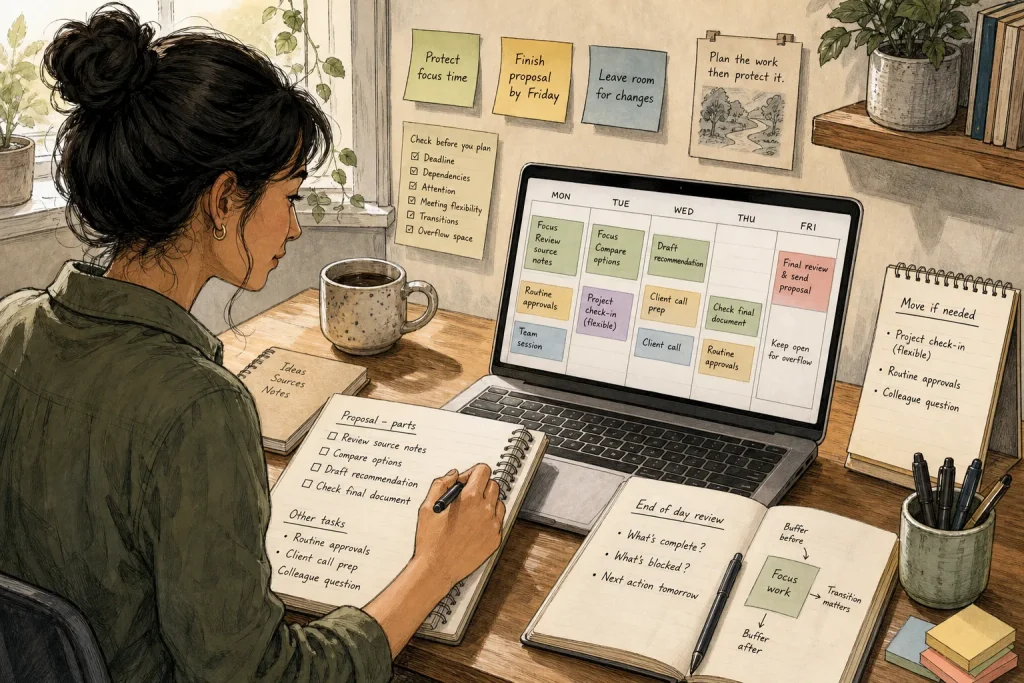
On Sunday evening, Maya opens her calendar to find a client call, a team planning session, and several project check-ins already in place. Her Friday proposal deadline is nowhere on the schedule. Until now, she has treated meetings as the week’s structure and hoped the writing would fit between them. This time, she starts with the proposal and other essential work, then looks for meeting times that can move.
Maya’s situation is hypothetical. It shows a common gap in digital calendars: they record when others expect your attention, but not necessarily what your work needs. A task-first calendar connects the task list to real blocks of work without pretending that every hour can be controlled.
Separate essential work from open tasks
Maya gathers tasks from her notebook, email flags, and project board. Before adding anything to her calendar, she sorts the list by deadline, attention required, and flexibility. The proposal has a firm deadline and needs concentrated analysis. A routine approval is necessary but can be handled in a shorter opening. A question from a colleague may need a response, but its timing depends on what the colleague needs.
She breaks the proposal into visible parts: review source notes, compare options, draft a recommendation, and check the final document. This is more actionable than a single calendar entry labeled “proposal.” It also makes dependencies clear: the recommendation should follow the comparison, and the final check should follow the draft.
Keep task details in a list or project board rather than turning every small action into a calendar appointment. The calendar should show when you intend to work; the task list can hold links, notes, and the next action for each item.
Distinguish fixed meetings from movable ones
Before placing work blocks, Maya checks which calendar events are genuinely fixed. The client call and team session stay in place. A project check-in has a flexible time, so she can ask whether it can move away from the morning reserved for analysis. This is a practical check, not a rule that meetings should always yield to solo work.
For each task, she uses a rough effort label such as brief, moderate, or substantial. These labels are planning aids, not exact predictions. Reviewing notes and comparing options both need sustained attention; sending an approved document does not. That distinction helps her match the task to an appropriate opening instead of filling every gap with work that may not fit.
She also accounts for transitions. A focused block that ends just before a call needs room to save notes, gather call materials, and change context. If the calendar is too tight to allow that, Maya shortens the work block or moves it rather than assuming the transition will take care of itself.
Group work by attention and materials
Maya schedules the proposal review and option comparison in an early-week focus block, then sets a separate block for drafting. She places client-call preparation near the call, when the relevant notes will be easy to find, and batches routine approvals together. The arrangement limits unnecessary switching between project files, email, and unrelated tasks.
Each calendar block has a useful description. “Compare proposal options using the source notes” tells Maya what to open and what progress should look like. A vague label such as “work” would leave her to reconstruct the plan when the block begins.
A calendar app can hold the blocks, while a paper notebook, shared document, or project board holds supporting details. The tool matters less than keeping the next action easy to locate. If a block is interrupted, a brief note about where to resume can make returning to the work less costly.
Leave room for changes and choose what can move
Maya does not fill every open space. She keeps a later-week opening available for overflow and avoids placing the proposal’s final review directly after a demanding meeting. If the analysis takes longer than expected, the open period gives her somewhere to continue without immediately displacing every other commitment.
She marks the final review as work to preserve and identifies routine approvals as movable. This gives her a decision rule if a new request arrives: protect the work tied to the Friday deadline, then move a lower-impact task if needed. Unscheduled time is not automatically wasted; it may absorb a change, or remain available for a task that becomes more urgent.
When deciding what to move, check the task’s deadline, dependencies, and consequence of delay. If moving it would block someone else or create a deadline problem, keep it in place and reconsider a more flexible task. If it has no near-term dependency, move it to a specific later slot or leave it on the task list for the next review.
Use a short review to keep the calendar workable
At the start of the day, Maya checks whether the next work block still fits the current calendar. If a meeting has shifted, she moves the least disruptive task first rather than sliding the entire week. At day’s end, she notes what is complete, what is blocked, and the next action for the following morning.
Use these checks when building or revising a task-first week:
- Deadline: Check the due date against the proposed work block. If the block leaves too little time for drafting and review, then move an earlier task block forward; otherwise, keep the planned sequence.
- Dependencies: Check whether another person, file, or decision must come first. If the prerequisite is missing, then schedule the request or decision before the dependent task; otherwise, keep the task in its current block.
- Attention: Check whether the task needs uninterrupted concentration or can be done in a short opening. If it needs focus, then place it in a quieter block; otherwise, group it with similar brief actions.
- Meeting flexibility: Check whether the meeting time is fixed or adjustable. If it can move and conflicts with essential work, then ask to shift it; otherwise, preserve the meeting and find another work block.
- Transitions: Check what must happen before and after the block, such as opening source files or preparing for a call. If the calendar leaves no room for that transition, then add a buffer or shorten the block; otherwise, leave the sequence as planned.
- Overflow space: Check whether any open period remains for unexpected work or tasks that run long. If none remains, then move a lower-priority task off the calendar; otherwise, keep the open period available.
- End-of-day status: Check what is finished, blocked, or still unclear. If a task is blocked, then record the missing input and schedule the next action; otherwise, mark it complete and choose the next task.
Work through a hypothetical proposal week
Suppose Maya starts with a Friday proposal deadline, two fixed meetings, one movable check-in, and a task list containing source-note review, option comparison, drafting, client-call preparation, and routine approvals. These are invented details for illustration, not a claim about a real workplace.
First, she puts the four proposal tasks in dependency order: review notes, compare options, draft, then check the final document. Next, she reserves an early-week focus block for the review and comparison, with a transition before the next meeting. She asks to move the flexible check-in away from that block. She places drafting in a separate quiet period, prepares for the client call near its scheduled time, and groups routine approvals in a shorter opening.
Finally, she leaves a later-week opening unassigned and schedules the final document check before the Friday deadline, not immediately after the last meeting. The resulting plan gives the proposal a clear sequence and gives overruns somewhere to go. The tradeoff is that a routine approval may move if the analysis takes longer; if the open period is not needed, she can use it to clarify the recommendation before sending the draft for review.
A task-first calendar works best as a revisable draft. Put work on the schedule before the remaining openings disappear, make the next action visible, and decide in advance which tasks can move. That small distinction helps a calendar represent not only who expects your time, but what the week needs to accomplish.